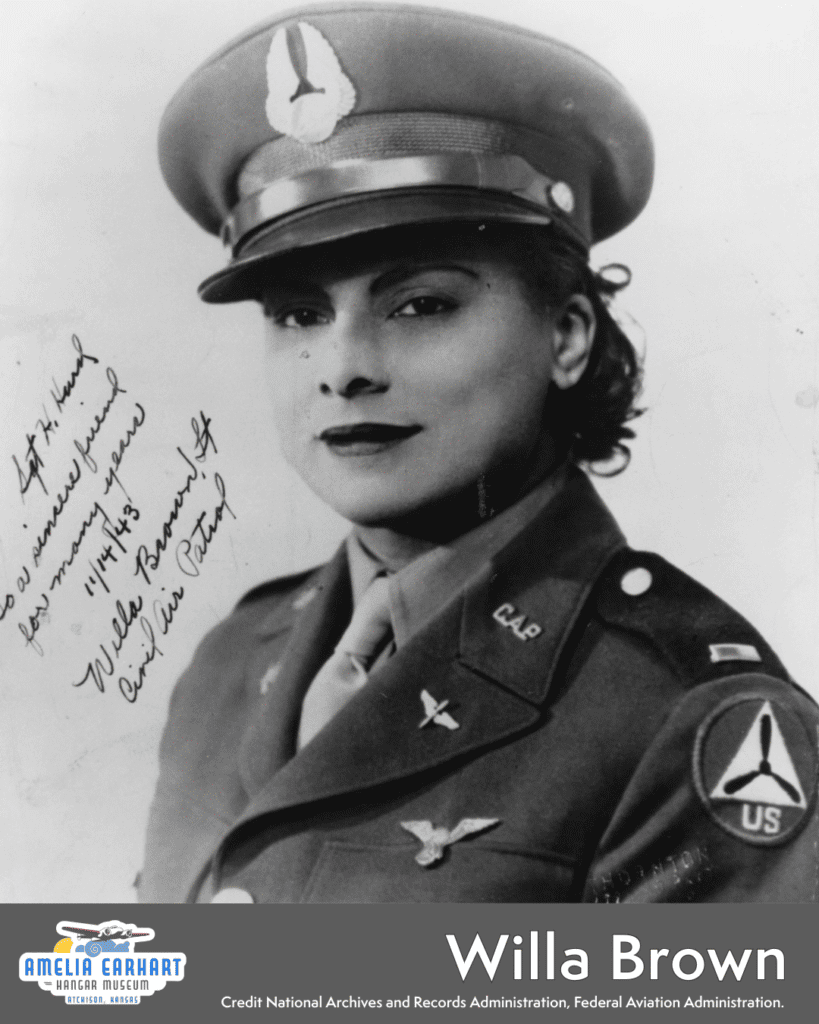
The remarkable Willa Beatrice Brown (1906 – 1992) was a trailblazing aviator, businesswoman, and activist for the inclusion of Black pilots. She accomplished many first as a Black woman in aviator, and equally important, worked tirelessly to break down barriers and pave the way for her Black contemporaries to also succeed.
Inspired by the great Bessie Coleman, Willa’s fascination with flight began in Chicago where she was working as an educator and social worker. Her flight training began in 1934 and she joined the Chicago Girls Flight Club. Soon after, she earned her master’s degree in business administration from Northwestern University and a master mechanic’s certificate from Curtiss-Wright Aeronautical University. She earned her pilot’s license in 1937 at Chicago’s segregated Harlem Field, first African American to earn her commercial pilot’s license and mechanic’s certificate in the United States. Concerned about the lack of opportunity for African Americans in the aviation industry, she co-founded d the National Airmen’s Association of America with her flight instructors and mentors John Robinson and Cornelius Coffey. The first black aviation professional association, the group sought to support Black pilots and advance opportunities for them in segregated America. Willa served as national secretary and president of the Chicago branch. At the same time, Willa and her now husband, Cornelius Coffey together grew Coffey School of Aeronautics, the first Black owned and operated aviation school.
The time was 1940, and World War II was looming. When a Time magazine article alerted the public to the dire need for more trained pilots and referenced the Coffey school, Willa seized the opportunity. She lobbied the government to permit Blacks to fully serve as pilots and airmen in the U.S Armed Forces. Her persistence paid off when Willa was named a federal coordinator and the Coffey Aeronautics School was chosen by the U.S. Army Air Corps to prepare African Americans to train men who later continued their training at Alabama’s Tuskegee Institute. Willa was directly responsible for training over 200 men and instructors who became the segregated 99th Fighter Squadron of the Tuskegee Airmen.
Willa’s efforts also extended to the Civil Air Patrol, a group dedicated to using civilian aviation resources to support the war effort with courier services, ant-submarine missions, and border patrols. In 1942, Willa was named an officer, the first woman and first African American to serve in a leadership role. Her desire to serve in the Women Airforce Service Pilots (WASP) when it formed in 1934, was denied. Despite her flying expertise, training credentials, and her master mechanic’s certification, her application was denied. The reason given was her race.
After the war, Willa and Cornelis closed the Coffey Aeronautical School and divorced. She continued in an education role, teaching business administration and aeronautics at a Chicago high school until retired in 1971. Her expertise led to her appointment to the Federal Aviation Administration’ Women’s Advisory Board in 1972. Willa passed away in 1992, laid to rest in Lincoln Cemetery in Chicago long with Bessie Coleman. In 2002, Willa’s legacy was honored when she was posthumously named one of Women in Aviation’s 100 Most Influential Women in Aviation and Aerospace.
Despite her personal setbacks, she spent her life educating and advocating for African Americans in the aviation field. Her devotion to justice paved the way for many future African American aviators to follow in her footsteps. The Pittsburgh Courier called her “Queen of the Airlines,” in a 1941 article.
Enjoy content from Amelia Earhart Hangar Museum? Make us one of your preferred sources on Google.