

Students Love Amelia Earhart
Amelia Mary Earhart (1897-1937) remains one of the most beloved women aviators in American history because of her trailblazing accomplishments, and her mysterious disappearance July 2, 1937, over the Pacific Ocean attempting to circumnavigate the globe. Students continue to be fascinated by her story and want to learn more. These resources will help get them started in that quest!
Who Was Amelia Earhart?
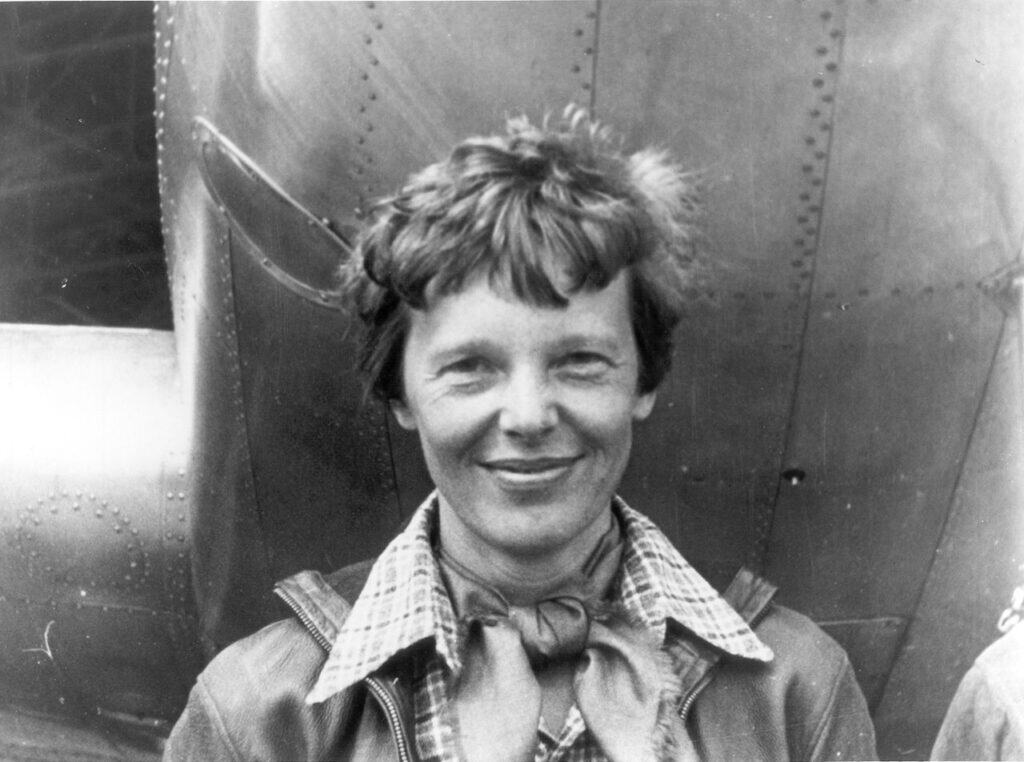
One of the biggest names in aviation is that of Amelia Earhart (1897-1937), the famous pioneering aviator from Atchison, Kansas. Amelia is remembered for becoming the first woman to fly across the Atlantic Ocean, and for her ill-fated flight around the globe when she disappeared without a trace in 1937. Her disappearance remains one of the greatest mysteries of the 20th and 21st centuries.
Pioneering Childhood
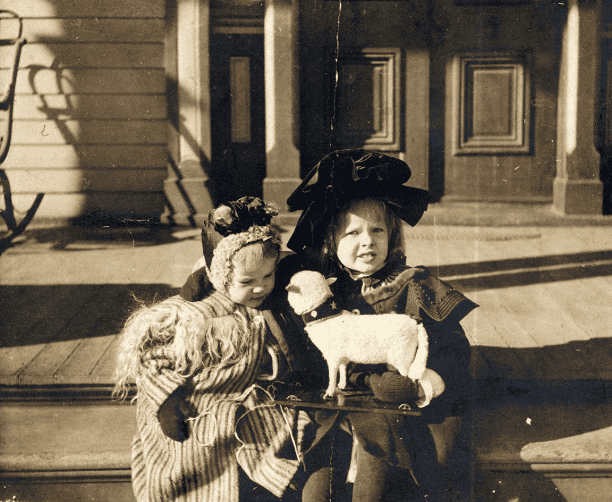
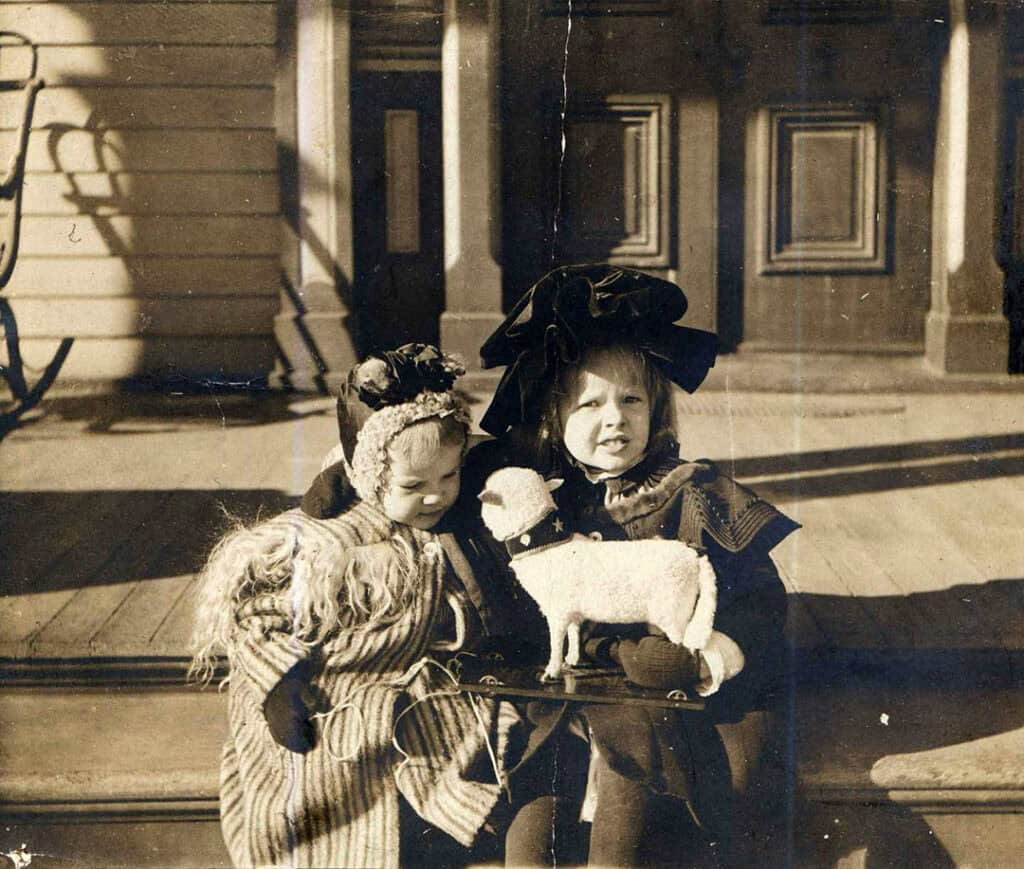
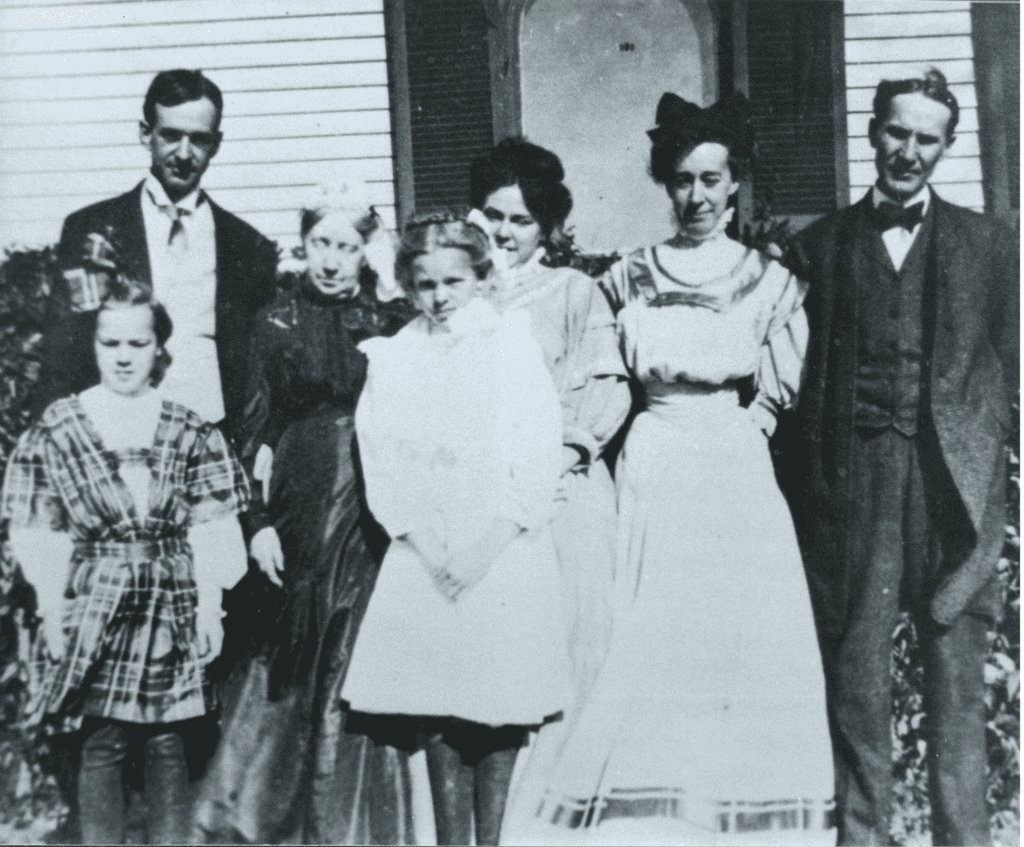
Amelia’s childhood experiences helped develop her curiosity, independence, and pioneering spirit. Amelia was born on July 24, 1897, to Edwin and Amy Earhart in her grandparents’ home in Atchison, Kansas. She spent summers with her parents in Kansas City, Kansas, and received her elementary education in Atchison where she lived during the school year with her maternal grandparents, Alfred and Amelia Otis. Amelia and her younger sister Muriel benefited from an unconventional lifestyle compared to most young girls of the time. Growing up with their wealthy grandparents, they were encouraged to explore nature and the outdoors. Amelia collected bugs and her mother taught her the basic biology of a chicken while preparing their dinner. Her mother even made bloomers (loose fitting girls’ pants) for her to wear while exploring instead of the more typical skirt. Amelia’s adventurous childhood slanted toward tom-boyish endeavors: collecting bugs, climbing trees, hunting rats, and playing sports (her father gifted her a football and a rifle).
Her sense of curiosity and adventure sparked her interest and her passions. In 1904, the Earhart family went to St. Louis to see the World’s Fair. The Scenic Railway rollercoaster exhibit, the “flying cars,” caught Amelia’s attention, and she wanted to ride the attraction. She was deemed too young and small by her mother and when the family returned home to Kansas City, Amelia convinced her sister, uncle, and a neighbor to build a small coaster with her off the family’s shed in the back alley. Amelia rode the ride once before her mother demanded that the contraption be taken down, but Amelia had had her first taste of “flying.” While air flight was still in its infancy, Amelia saw her first airplane at 1908 Iowa State Fair. Not impressed, she called it, “a thing of rusty wire and wood and not at all interesting.”
Amelia also experienced hardship in her childhood which led to her fierce independence. Her father, Edwin Earhart, was an attorney for railroads, but often struggled to keep secure jobs, forcing the Earhart family to move frequently. Amelia and her family moved more than five times between 1910 and 1920 to Iowa, Illinois, Missouri, and Minnesota. Her father also struggled with alcoholism, which put a strain on the family. When Amelia was older, her mother moved the children to Chicago, Illinois, to live with friends where Amelia graduated from high school. She loved to read and excelled in the sciences but had trouble making friends. Her yearbook caption read, “A.E. – the girl in brown who walks alone.” In Chicago, the family continued to experience financial difficulties. They took in boarders (people who pay rent to live in a home) to help pay their bills and Amelia once re-purposed draperies into a dress to wear to a dance. The family didn’t always struggle though. Amelia’s mother inherited money from her parents, and for a time, Amelia and her sister Muriel attended boarding schools for young girls. Amelia attended Ogontz School for Young Ladies in Rydal, Pennsylvania. Her sister attended a school in Toronto, Canada. During World War l, while visiting her sister, Amelia worked as a nurse’s aide in Toronto, Canada. Later, she enrolled in medical courses at Columbia College. Her desire to help others later took her to Boston where she worked as a social worker. A great sadness for Amelia as a young adult was the divorce of her parents.
In an age when aviation was incredibly dangerous, and there were many unknowns, Amelia leapt to the challenge. Leaping into the unknown helped her achieve the adventure and independence she craved and the control she lacked so often during her childhood. Above the clouds she was able to remove herself from the cares she had known on the ground.
Navigating Celebrity
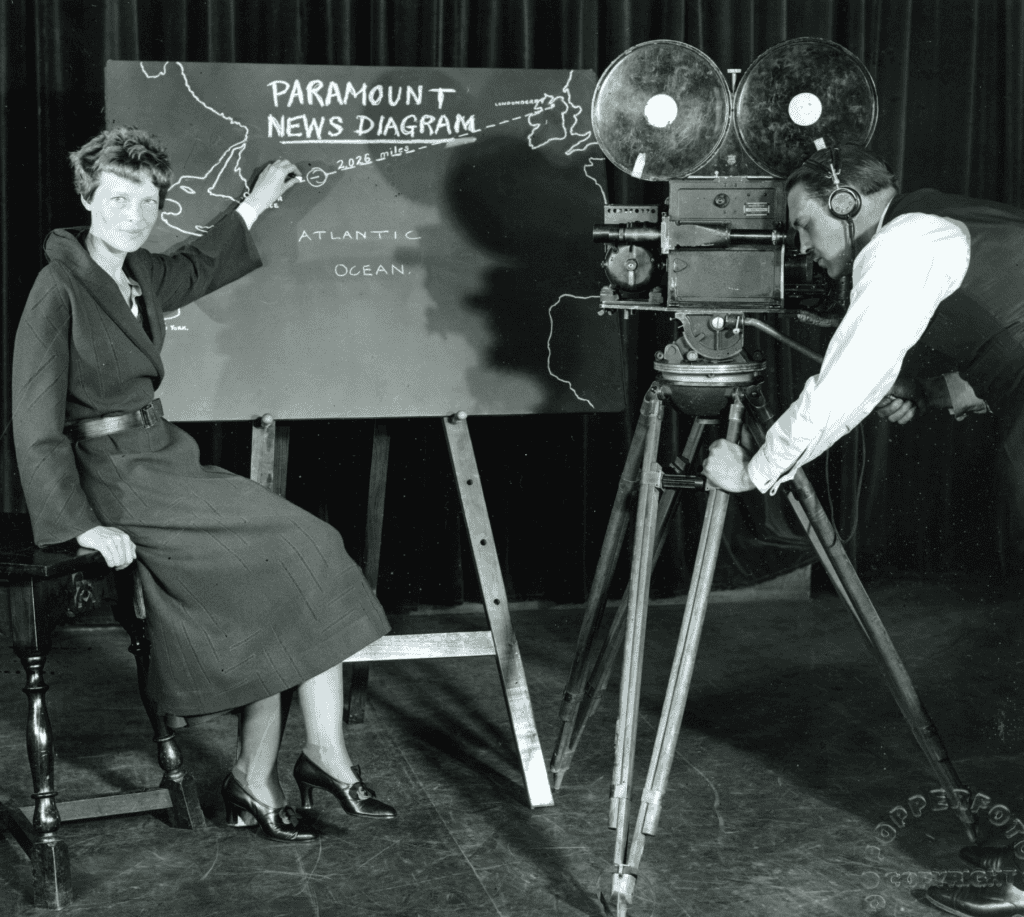
Through perseverance and hard work, Amelia reached her dream of making her living from aviation. In her early flying days, Amelia worked whatever odd jobs she could to make money for flying. She drove a gravel truck, tried her hand at photography, worked for her father’s law office, and worked as a telephone operator. Publicist George Putnam (who went on to become her husband) sought out Amelia in 1928 for a historic flight – the first woman to across the Atlantic Ocean in a plane. Despite the dangers, Amelia jumped at the chance. 40% of the attempts to fly across the Atlantic in 1927 had failed, with 25% proving fatal. The Fokker F.VII aircraft, named Friendship, was flown by pilots Wilmer Stultz and Lou Gordon. The flight was a success, and Amelia became the first woman to cross the Atlantic Ocean – but as a passenger, not a pilot. She was determined to be piloting the plane on her next trip.
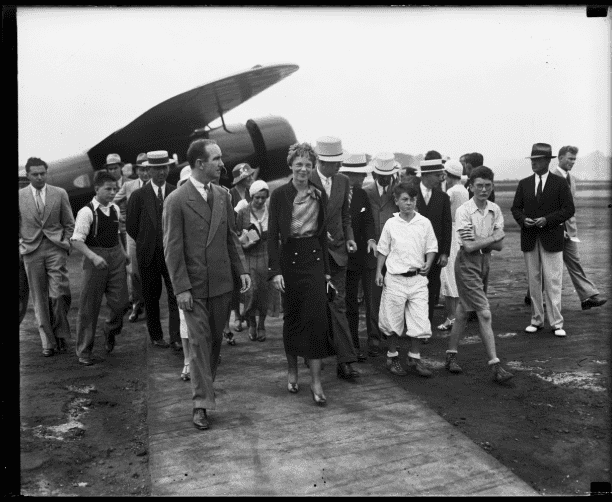
Amelia shot to international fame, returning to a homecoming parade in New York City. She quickly wrote her first book about the experience, 20 Hrs. and 40 min., with the support of Putnam, and a speaking tour followed. By the end of 1928, Amelia visited more than thirty cites and spoke to one hundred groups. As a shy person who didn’t seek fame, the pressures of her celebrity and speaking schedule were tiring for Amelia, but she persevered to promote aviation and keep flying.
She used her new-found celebrity platform to advocate for issues important to her. Believing that women lacked the same opportunities in aviation as men, she urged more piloting opportunities for women and mechanical training for girls. Amelia, like many other women pilots, experienced prejudice and discrimination in the male-dominated aviation industry. Together, with ninety-eight other female pilots, Amelia founded The Ninety-Nines in 1929 to advance women aviators. The group chose Amelia as their first president.
Once her flying career was her full-time job, she pursued other interests like designing a women’s clothing line. Inspired by her unconventional childhood and her need as a pilot for practical and comfortable clothing, she launched Amelia Earhart Fashions in 1934. One of the first celebrities to do delve into fashion, she even modeled the clothes in advertisements. In 1935, a line of lightweight travel luggage, emblazoned with her name, followed. Her writing career continued, with the role of aviation editor of Cosmopolitan and articles written for National Geographic. Putnam promoted these endeavors, and even arranged product endorsements, all with the goal of earning money to fund Amelia’s true passion – flying!
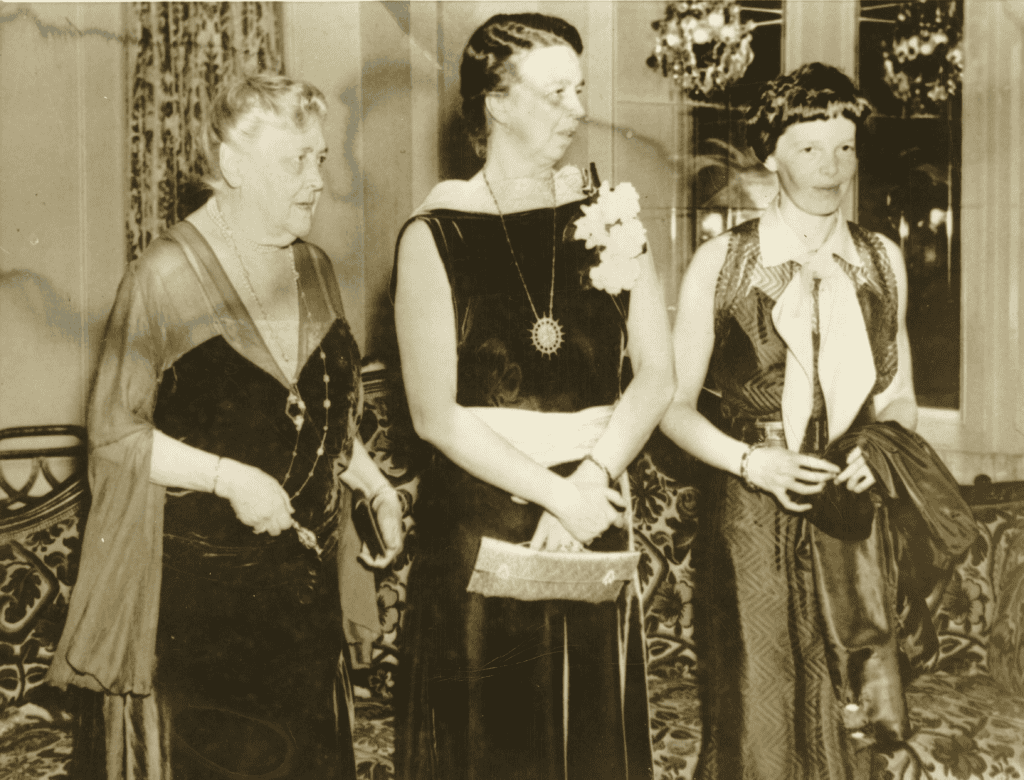
Amelia also spoke to the United States Congress and made speeches as she gained fame and popularity. She was a friend of First Lady Eleanor Roosevelt and spoke to President Herbert Hoover in support of the Equal Rights Amendment, calling for equal rights for women. As a result of her speeches, she was offered a job as a counselor to young women who were students at Purdue University.
Despite her intense focus on her career, Amelia married her publicist George Putman in 1931 at the age of 33. She didn’t seek a traditional marriage for the time. She insisted on keeping her maiden name and continuing her aviation career. In a letter that she wrote to Putnam prior to their wedding, she also requested that matters were to remain private within their marriage and that if the two did not find happiness with each other within the first year, they would agree to part ways. Putnam was a good match for her, as he understood her obligations better than anyone. Their marriage lasted six years, ending only with her disappearance in 1937.
Amelia in Flight
Amelia’s groundbreaking tenacity and passion for flying pushed her to pursue her dreams and reach groundbreaking heights. As a child, she had seen planes a few times before she first climbed aboard one as a passenger in late December 1920. Once she got in the air, she was hooked. In her own words, “When I came down, I was ready to sign up at any price to have a try at the air myself.”
She began flying lessons in early 1921 with female pilot Anita “Neta” Snook and received her international pilot’s license (the 16th woman to do so) two years later. Amelia was a pioneer during aviation’s early years when piloting was still very dangerous. Early aircraft were flimsy, made of wood and canvas, and engines were very loud. Pilots flew at low altitudes because cockpits were not pressurized, and that caused a lot of bouncing and air sickness. Weather conditions created unpredictable flights. Pilots flew most safely during the daytime when they could navigate by following major landmarks.
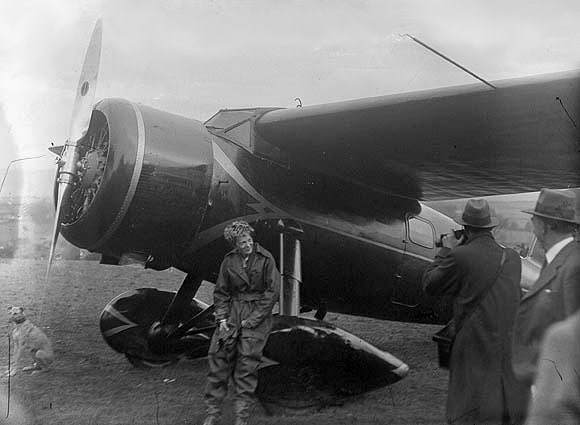
By 1925, Amelia was working as a social worker at the Dennison House outside of Boston and flying out of the Medford Airfield when she was selected as the first woman passenger to fly across the Atlantic Ocean. Afterward, she was determined to pilot a plane over the Atlantic. She was not alone in that quest, and the Ortieg Prize of $25,000 was offered to the first pilot to ever cross the Atlantic on a solo flight. It was extremely dangerous to fly over vast bodies of water, and quite a lot of pilots, both men and women, died in their attempts to do so. Charles Lindberg successfully crossed in 1927 winning the prize, and five years later, Amelia Earhart succeeded as the first woman. She took off from Newfoundland on May 20, 1932, and landed in Londonderry, Northern Ireland, 15 hours later. She flew her red Lockheed Vega 5B, made of wood and canvas, and nicknamed her “Little Red Bus.” It was a difficult trip, including equipment failure and flying through a storm at night. Her success cemented her as an international aviator, nicknamed “Lady Lindy” due to her resemblance to Lindbergh.
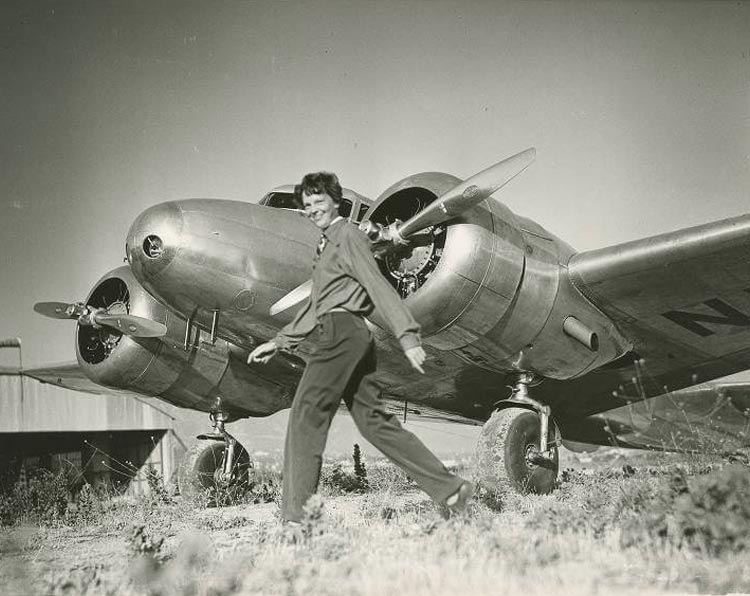
Between her two Atlantic flights, Amelia devoted herself to flying. She competed with twenty other pilots in the first women’s air race in 1929, flying over eight days from Santa Monica, California, to Cleveland, Ohio. Amelia placed 5th in the race, and sadly Marvel Crosson lost her life during the race. At the time, many men did not believe women should race airplanes, and this prejudice against women sparked the formation of The Ninety-Nines, now an international organization for supporting women pilots. Amelia pursued every dream and record she could, holding records for highest altitude and speed. She also had many firsts in aviation: she was the first woman to fly across the continental United States, the first person to fly across the Pacific Ocean from Hawaii to California, and the first person to fly directly over the Gulf of Mexico on her solo flight from Mexico City to New Jersey. She never stopped reaching to achieve new aviation feats. (Detailed timeline of her flights) In her lifetime she owned four aircraft, in this order: Kinner Airster, Avro Avion, Lockheed Vega 5B and her final plane, the Lockheed Electra 10-E. Her final quest was a 28,000 mile trip around the world in 1937.
Amelia’s Final Flight
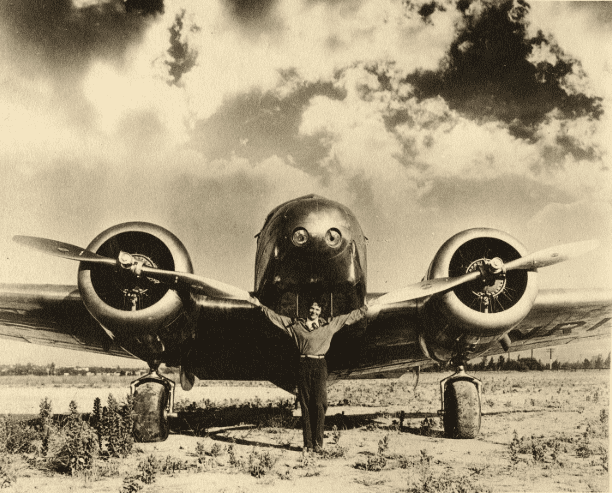
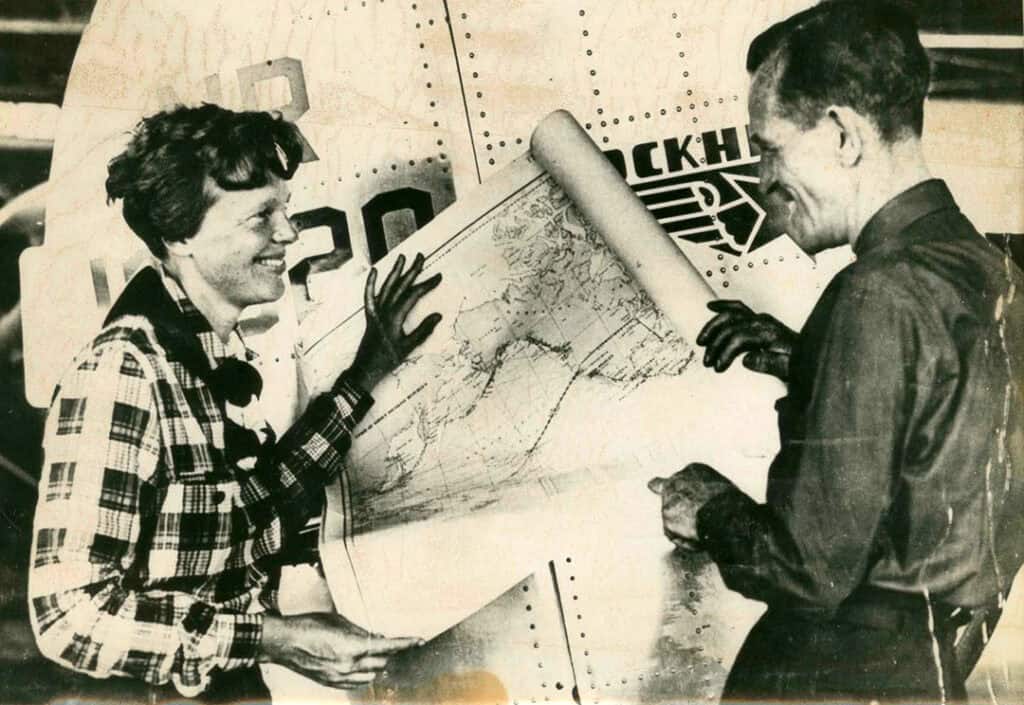
By 1937, only one major feat eluded Amelia – an around the world flight. Others had accomplished this, most notably by Wiley Post in 1930, and clocking 15,474 miles. Amelia wanted to prove she could make the flight around the equator, an astounding 28,000 mile mission. Amelia was nearing the age of forty in the summer of 1937, and had begun telling some of her closest friends that her attempt to fly around the world would be her last major flight. The preparations for this final excursion began in early 1936 when Purdue University agreed to help cover the $60,000 price tag for a customized Lockheed Electra 10-E airplane. Amelia worked with Lockheed to add four additional fuel tanks, a Sperry autopilot system, and radio and navigation equipment. Amelia extensively researched the equipment to better understand the fatigue of the plane under various conditions, along with how exhaustion from flying for so long would affect her and Fred Noonan, her in-flight navigator for the flight.
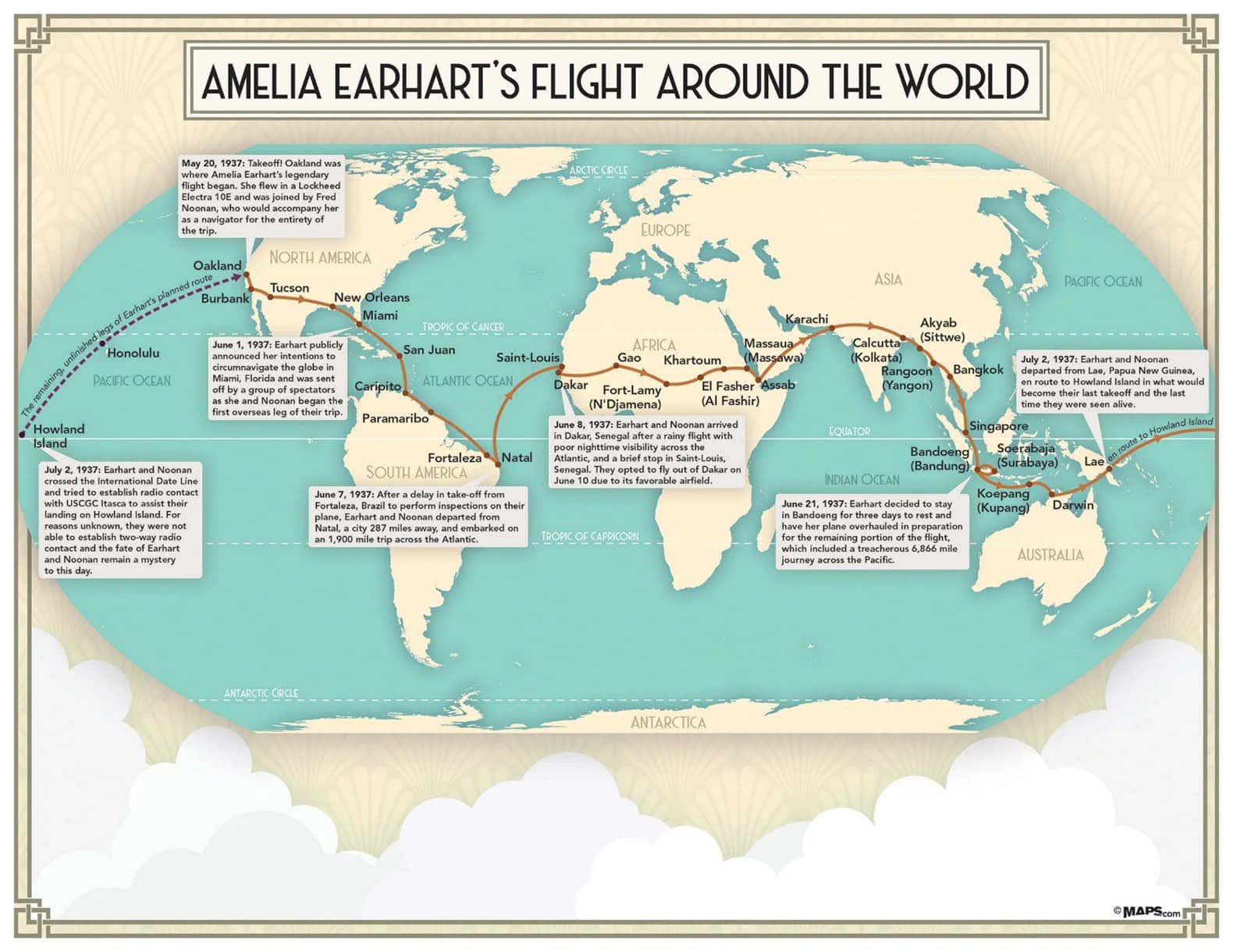
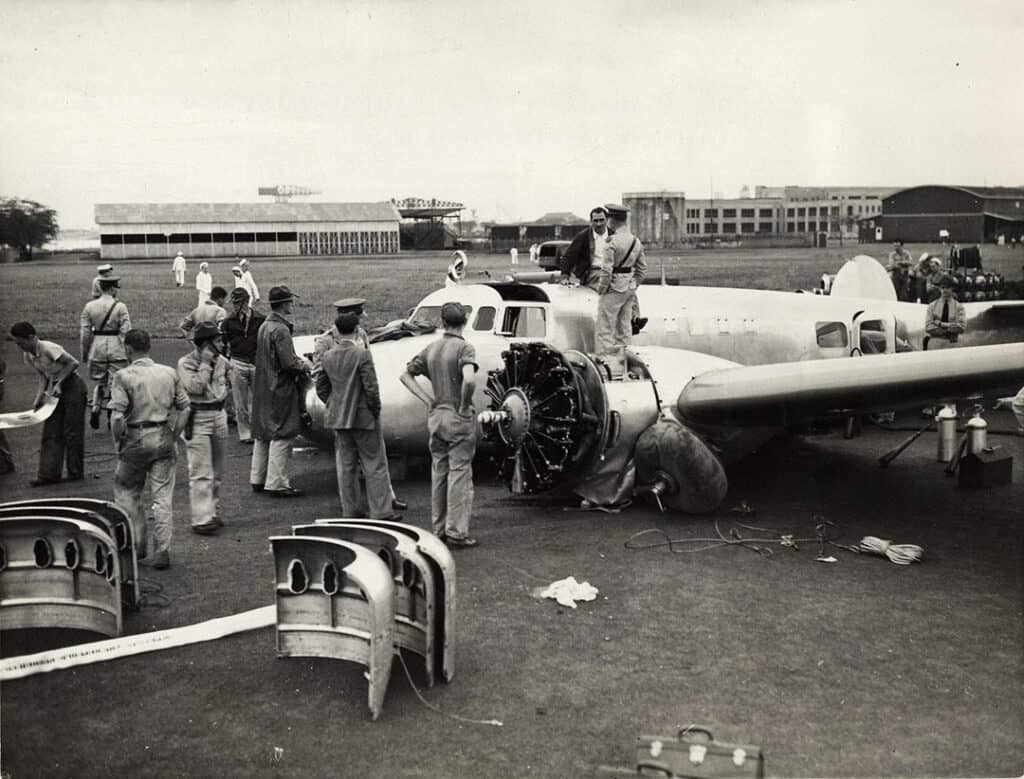
In March of 1937, Amelia made her first attempt to circumnavigate the globe. On the second leg of the trip, while taking off in Hawaii, the Lockheed’s landing gear snapped causing one wing to collapse and spin out on the runway. The damage was extensive and required two months of repairs.
The delay caused a change in her flight plan based on weather conditions, and she took off for the second time from Oakland, California, on June 1, 1937, traveling first across the United States. Instead of flying to Howland Island within the first week of her world flight, Amelia was now going to fly across the dangerous, vast Pacific Ocean on her last stops. It had been an exhausting trip, flying a large plane with loud engines, in extreme heat, and with little food. Physically, she slept little and suffered from nausea and diarrhea.
On the morning of July 2, 1937, after Amelia had been flying almost daily for five weeks, she was expected to land on tiny Howland Island in the middle of the Pacific. At 8 AM on that morning, Amelia was communicating by radio with the Coast Guard Itasca ship waiting off the coast of Howland Island. In her last message received by the Itasca, Amelia said, “We must be on you but cannot see you. Gas is running low. Been unable to reach you by radio. We are flying at 1,000 feet.” She was never heard from again.
The official search for Amelia began within hours after her last radio contact. The seventeen-day search by air and sea was the most expensive in U.S. history at that point. Over $4 million ($17 million in today’s dollars) were spent covering 150,000 square miles surrounding Howland Island. No evidence was found. Eighteen months later, on January 5, 1939, Amelia’s husband petitioned the court to have Amelia declared dead.
To this day, no one has ever found any evidence of the crash and despite many claims, all have been debunked. Many have theorized what might have happened, suggesting she simply ran out of gas and crashed into the ocean, she landed on a different island where she died of starvation or injury, and that she planned her disappearance to start a new, anonymous life. The search to solve the greatest mystery of the 20th and 21st centuries continues, with new explorers seeking to go down in history as the one to find the missing Amelia Earhart.
Additional Resources
Want even more Amelia? Here are documents and additional resources to go even deeper on your educational journey.
If you have additional questions, email the Museum staff at [email protected].

Join Our Newsletter
Want to stay up to date with all things Amelia Earhart? Join our newsletter to stay in the loop!