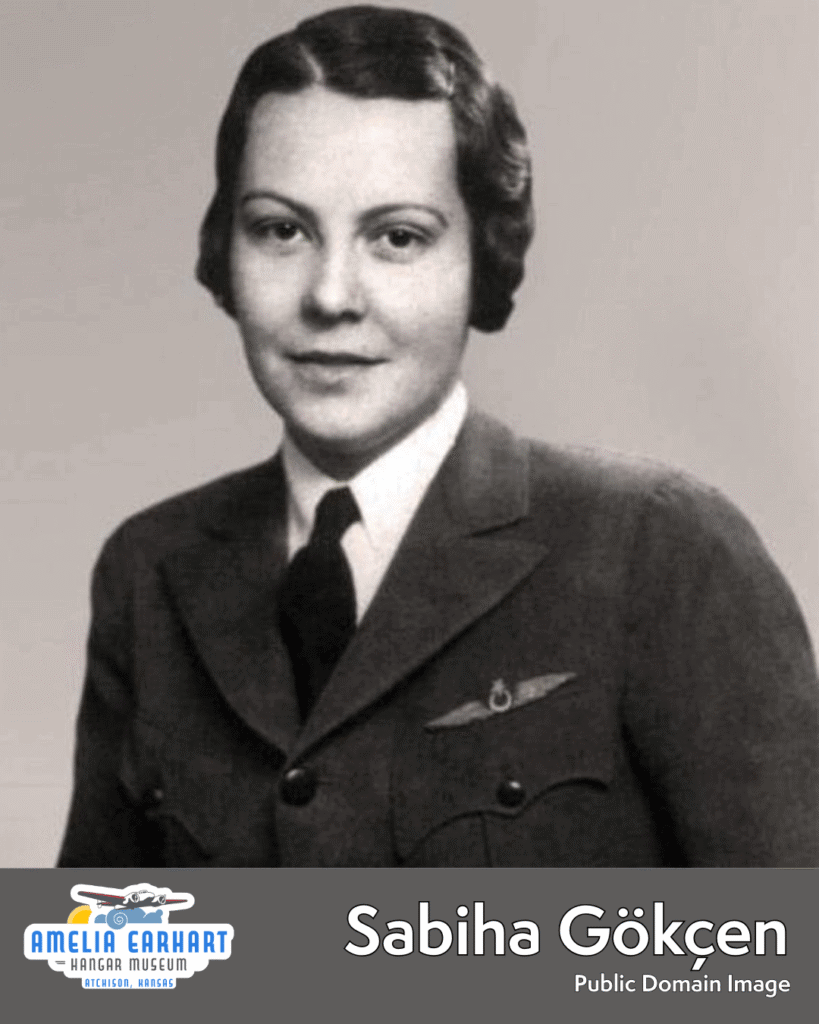
Sabiha Gökçen (1913 – 2001) orphaned as a child, grew up to be the first female air combat pilot. Adopted by Mustafa Kemal Atatürk, the first president of the future Republic of Turkey, Sabiha had many privileges. She attended boarding school and was given her adopted surname Gökçen. ‘Gök’ means sky in Turkish and Gökçen means ‘belonging or relating to the sky,’ a serendipitous nod to her future. Sabiha became interested in aviation when attending the opening ceremony of the Türkkuşu Flight School in 1935. Her adoptive father asked if she wanted to become a skydiver, and she excitedly said yes. He instructed the school’s head to enroll Sabiha as the first female trainee.
During her time in flight school, Sabiha gravitated towards flying more than skydiving and soon earned her pilot’s license. She was sent to Russia with seven other students for an advanced course in glider and powered aircraft piloting. She flew a motorized aircraft for the first time in February 1936. She possessed relentless perseverance and earned the respect of her instructors. Due to Sabiha’s success, Atatürk enrolled her in the Turkish War Academy’s aviation school in 1936. Since women were not typically enrolled, Sabiha received a personalized uniform. After graduating, she joined the 1st Airplane Regiment at Eskişehir Airbase.
Sabiha officially became the first female combat-ready pilot at age 23 when she took part in Turkish military operations in 1937. She participated in the Trace and Aegean exercises as well as the Dersim Operation. She was awarded a takdirname (letter of appreciation) and the Turkish Aeronautical Association’s first Murassa (Jeweled Medal). Although other women such as Marie Marvingt and Eugenie Shakhovskaya preceded Sabiha as military pilots, Sabiha was the first female fighter pilot. She flew 8,000 hours and 32 combat missions. In 1938, she became a flight instructor at the Türkkuşu Flight School of the Turkish Aeronautical Association, where she served until 1954. Sabiha retired entirely from flying in 1964. The Sabiha Gökçen International Airport in Istanbul is named after her. She is a shining example of women empowerment and a reminder that even the seemingly impossible dreams can become reality.
Enjoy content from Amelia Earhart Hangar Museum? Make us one of your preferred sources on Google.